What is Keyword Density and How to Calculate It?
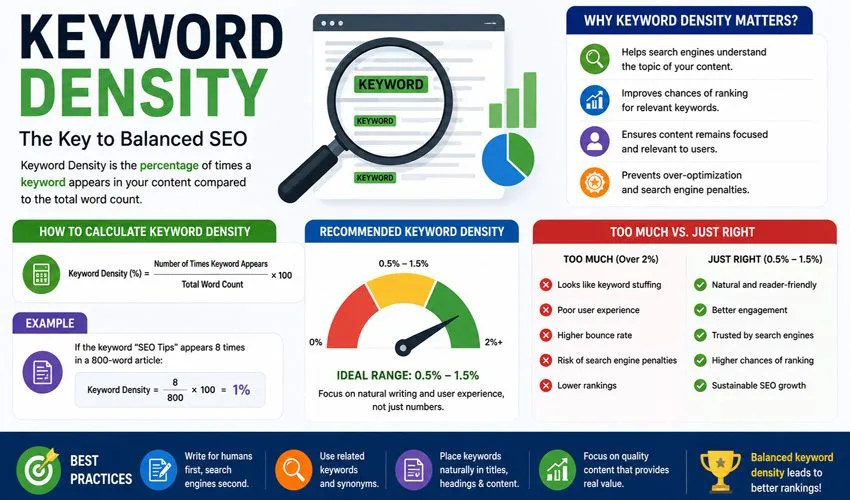
Keyword density is one of the most discussed concepts in Search Engine Optimization (SEO). It refers to the percentage of times a target keyword appears in a piece of content compared to the total number of words on the page. While keyword density was once a major ranking factor, modern search engines now focus more on content quality, relevance, and user intent. However, understanding keyword density remains important for creating well-optimized content that is both search engine-friendly and easy to read.
In this guide, we will explain what keyword density is, how to calculate it, why it matters, and the best practices for using keywords effectively in your content.
What is Keyword Density?
Keyword density is a measurement that shows how often a specific keyword or phrase appears within a webpage or article relative to the total word count.
For example, if your target keyword is “digital marketing” and it appears 10 times in a 1,000-word article, the keyword density can be calculated as a percentage.
SEO professionals use keyword density to ensure that content includes relevant keywords without overusing them. Proper keyword placement helps search engines understand the topic of a page while maintaining a natural reading experience for users.
Why is Keyword Density Important?
Keyword density helps search engines identify the primary topic of a webpage. When keywords are used naturally throughout content, search engines can better understand the relevance of the page to a user’s search query.
Some benefits of proper keyword density include:
Improved Content Relevance
Keywords help search engines determine what your content is about.
Better User Experience
Natural keyword usage improves readability and ensures that content remains valuable to visitors.
Enhanced SEO Optimization
Strategic keyword placement can support overall on-page SEO efforts.
Avoidance of Keyword Stuffing
Monitoring keyword density helps prevent excessive keyword repetition, which can negatively impact rankings.
Although keyword density is no longer a direct ranking factor, it remains a useful guideline for content optimization.
How to Calculate Keyword Density
The keyword density formula is straightforward:
Keyword Density (%) = (Number of Keyword Occurrences ÷ Total Number of Words) × 100
The formula can be represented as:
\text{Keyword Density}=(\frac{\text{Keyword Occurrences}}{\text{Total Words}})\times100
Example Calculation
Suppose you have:
- Total words in article: 1,000
- Keyword occurrences: 15
The calculation becomes:
(\frac{15}{1000})\times100=1.5%
In this example, the keyword density is 1.5%.
This means the target keyword appears in 1.5% of the content.
What is the Ideal Keyword Density?
There is no official keyword density percentage recommended by search engines. However, many SEO experts suggest keeping keyword density between 1% and 2%.
For example:
- 500-word article: 5–10 keyword mentions
- 1,000-word article: 10–20 keyword mentions
- 2,000-word article: 20–40 keyword mentions
These figures are general guidelines rather than strict rules.
The primary goal should always be to write naturally and provide value to readers.
Understanding Keyword Stuffing
Keyword stuffing occurs when a keyword is used excessively in an attempt to manipulate search engine rankings.
For example:
“Digital marketing is the best digital marketing strategy because digital marketing helps businesses grow through digital marketing techniques.”
This type of writing sounds unnatural and creates a poor user experience.
Search engines can recognize keyword stuffing and may reduce the visibility of such content in search results.
Instead of repeating the same phrase excessively, use related terms and variations.
Types of Keywords to Consider
Modern SEO focuses on a broader range of keyword usage rather than repeating a single keyword.
Primary Keywords
These are the main keywords you want your content to rank for.
Example:
- Keyword Density
Secondary Keywords
Supporting keywords that relate closely to the primary topic.
Examples:
- SEO optimization
- On-page SEO
- Search engine ranking
Long-Tail Keywords
Longer, more specific keyword phrases.
Examples:
- How to calculate keyword density
- Ideal keyword density for SEO
Semantic Keywords
Words and phrases that are contextually related to the topic.
Examples:
- Content optimization
- Search visibility
- Organic traffic
Using a combination of keyword types helps create comprehensive and natural content.
Where Should Keywords Be Placed?
Keyword placement is often more important than keyword density.
Important locations include:
Title Tag
Include the primary keyword in the page title.
Meta Description
Use the keyword naturally in the meta description.
Headings
Place keywords in H1, H2, and H3 headings where relevant.
Introduction
Mention the target keyword early in the content.
Conclusion
Include the keyword naturally in the closing section.
Image Alt Text
Use descriptive keywords when appropriate.
Strategic placement helps search engines understand the content without relying solely on keyword frequency.
How Search Engines View Keyword Density Today
Search engines have become much more sophisticated over the years.
Modern algorithms focus on:
- User intent
- Content quality
- Topic relevance
- User engagement
- Content depth
- Semantic relationships
Rather than counting exact keyword repetitions, search engines analyze whether the content comprehensively addresses a topic.
For example, an article about SEO may rank well even if it does not repeatedly use the term “SEO” because it includes related concepts such as rankings, backlinks, content marketing, and search visibility.
This approach is often referred to as semantic search.
Tools for Checking Keyword Density
Several tools can help analyze keyword density.
Popular options include:
- Yoast SEO
- SEMrush
- Ahrefs
- Small SEO Tools
- SEO Review Tools
- Rank Math
- Surfer SEO
These tools provide insights into keyword usage and help identify potential optimization opportunities.
However, keyword density metrics should be used as guidance rather than strict requirements.
Best Practices for Keyword Density
To optimize content effectively, follow these best practices:
Write for Humans First
Always prioritize readability and user experience.
Use Keywords Naturally
Include keywords where they fit naturally within the content.
Focus on Search Intent
Understand what users are looking for and address their needs.
Use Synonyms and Variations
Avoid repeating the exact keyword excessively.
Create Comprehensive Content
Cover the topic thoroughly rather than focusing only on keyword frequency.
Optimize Headings
Include important keywords in headings and subheadings when relevant.
Monitor Readability
Content should flow naturally and be easy to understand.
Common Keyword Density Mistakes
Many content creators make mistakes when optimizing for keywords.
Overusing Keywords
Excessive repetition can harm readability and SEO performance.
Ignoring User Intent
Content should answer user questions rather than simply include keywords.
Focusing Only on Exact Match Keywords
Modern SEO values context and semantic relevance.
Neglecting Content Quality
High-quality content often outperforms heavily optimized but low-value pages.
Using Unnatural Language
Forced keyword placement creates a poor reading experience.
Avoiding these mistakes can significantly improve content effectiveness.
Keyword Density vs. Keyword Prominence
Keyword density measures how often a keyword appears.
Keyword prominence refers to where the keyword appears.
For example, placing a keyword in the title, first paragraph, and headings is often more impactful than repeating it dozens of times throughout the article.
This is why SEO professionals focus on both density and placement.
Conclusion
Keyword density is the percentage of times a keyword appears within content compared to the total word count. While it remains a useful SEO metric, it is no longer the dominant ranking factor it once was. Modern search engines prioritize content quality, relevance, user intent, and semantic understanding over simple keyword repetition.
To calculate keyword density, divide the number of keyword occurrences by the total word count and multiply by 100. Although a density of 1% to 2% is often considered a good guideline, there is no universally accepted ideal percentage.
The best approach is to create valuable, informative, and engaging content while using keywords naturally. By focusing on user experience and comprehensive topic coverage, you can improve both search visibility and reader satisfaction.