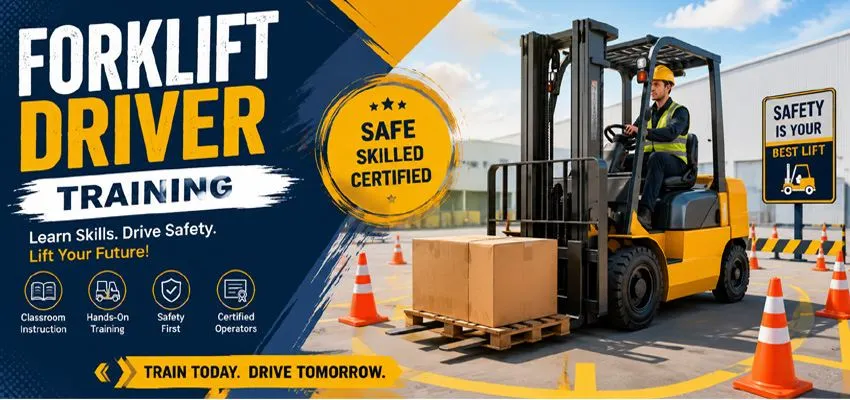
Forklift Driver Training: Requirements, Process, and Benefits
Forklift Driver Training in Australia
Forklifts are essential across Australian worksites — from large distribution centres and warehouses to construction sites and manufacturing facilities. They are relied upon to move heavy pallets, transport bulk materials, load trucks efficiently, and keep supply chains operating without delay. In many industries, daily productivity depends directly on skilled forklift operation.
A forklift is a powerful and sturdy piece of equipment in industries, but it is important to note its limitations, including its weight-carrying capacity, stability, and, most importantly, its potential for causing accidents if not used well. There is a risk of a forklift tipping over, dropping its load, colliding with people, and damaging equipment and buildings.
This is precisely the purpose and intent behind Forklift Driver Training, and it’s an essential requirement for all Australian workplace safety regulations. The training ensures that the forklift driver is aware of their legal requirements, how to identify hazards, how to calculate the load, and how to operate the forklift safely. The training combines theory with hands-on training, not merely some level of awareness.
Why Forklift Licensing Is Mandatory in Australia
In Australia, forklift operation falls under High Risk Work (HRW) licensing laws. These regulations are governed nationally and enforced at a state level by workplace safety authorities such as SafeWork NSW.
There are two primary forklift licence classes:
- LF (Forklift Truck Licence): Required for standard counterbalance forklifts
- LO (Order Picker Licence): Required for order-picking forklift trucks
If anyone operates the forklift without a valid HRW licence, they may be subject to heavy penalties. If the employer allows the workers to operate the equipment without the required licence, the employer may also be penalized. In addition, the issue of non-compliance also relates to the insurance and the company’s image.
It also ensures that the operators know their role at work, how to handle the loads, the safety rules in place, and how to react in emergency cases. A license also protects the operators and everyone else from the forklift.
Who Should Complete Forklift Driver Training?
Forklift certification is suitable for:
- Individuals entering warehousing or logistics roles
- Construction workers handling materials
- Manufacturing and factory staff
- Retail distribution employees
- Labourers seeking career advancement
- Employers wanting to upskill their teams
Even for an experienced worker who has learned on the job, it is still necessary for him or her to undergo an accredited course in order to secure a forklift license. Experience cannot fully replace the certification.
For job seekers, having forklift qualifications can greatly enhance their employability, while for employers, it ensures that their employees have completed their Forklift Driver Training and are safe at the workplace.
Eligibility Requirements for Training
Before enrolling in forklift training, candidates must meet specific criteria.
Minimum Age
Applicants must be at least 18 years old to apply for a High Risk Work licence.
Language, Literacy and Numeracy Skills
Participants must be able to read, write, and understand English sufficiently to complete written assessments and interpret safety documentation. Clear communication is vital in high-risk environments.
Identification Requirement
Participants must provide valid photo identification at enrolment and again during assessment. This verification step ensures all licensing documentation is accurate and processed efficiently by the relevant authority.
At Ace Forklift Training, we clearly explain these identification requirements before the course begins, allowing candidates to arrive fully prepared and avoid unnecessary delays in obtaining their High Risk Work licence.
What Does the Forklift Training Process Involve?
Many people feel unsure about what to expect from forklift training. Breaking down the process helps remove that uncertainty.
1. Theoretical Instruction
The course begins with classroom-based learning. This component covers:
- Workplace health and safety legislation
- Risk assessment procedures
- Pre-operational equipment checks
- Hazard identification
- Load calculations and stability principles
- Safe operating techniques
- Emergency response protocols
Understanding forklift stability is particularly important. Improper load distribution is one of the leading causes of tip-over incidents. The theory component builds a strong foundation before practical operation begins.
2. Practical Hands-On Training
After completing the theory, participants move to supervised practical sessions. Here, students learn to:
- Conduct pre-start inspections
- Manoeuvre safely in tight environments
- Lift, carry and stack loads
- Reverse and park correctly
- Navigate inclines and uneven surfaces
- Apply shutdown procedures
Practical training builds confidence and competence. Mistakes made in a controlled learning environment become valuable lessons rather than costly workplace incidents.
3. Formal Assessment
To obtain a licence, candidates must successfully complete:
- A written knowledge assessment
- A practical demonstration assessment
Assessments are conducted by an accredited SafeWork assessor. Once successful, participants can apply for their High Risk Work licence through the relevant authority.
Professional providers like Ace Forklift Training ensure assessments are conducted thoroughly and in line with current regulatory standards.
How Long Does Forklift Driver Training Take?
Most forklift courses run over two to three days, depending on the participant’s prior experience and licence type.
For beginners, this timeframe allows adequate opportunity to absorb theoretical knowledge and build practical skill. Shorter refresher programs may be available for experienced operators who need verification of competency.
It is important not to view forklift training as a quick formality. The purpose of Forklift Driver Training is to create safe, capable operators, not simply to issue a licence.
Key Benefits of Forklift Driver Training
While licensing is legally required, the broader benefits make it a worthwhile investment for individuals and businesses alike.
Improved Workplace Safety
Forklifts are powerful machines capable of causing serious injury if mishandled. Proper training reduces risks such as:
- Collisions with pedestrians
- Dropped loads
- Equipment damage
- Overturn incidents
- Racking system collapse
Well-trained operators are more aware of surroundings, weight limits, and hazard zones, creating a safer environment for everyone.
Stronger Legal Compliance
Compliance with High Risk Work legislation protects businesses from fines and legal disputes. Demonstrating that employees have completed Forklift Driver Training shows due diligence and commitment to safety.
Insurance providers also require licensed operators. In the event of an incident, documented training supports insurance claims and legal defence.
Increased Employability
For individuals, holding a forklift licence can open doors across multiple industries. Warehousing and logistics remain vital sectors in Australia’s economy, with consistent demand for skilled operators.
A forklift licence can:
- Increase earning potential
- Improve job stability
- Provide access to larger employers
- Support career progression into supervisory roles
Candidates with completed training are often prioritised during recruitment because they are immediately job-ready.
Greater Operational Efficiency
Trained operators work with greater accuracy and speed. They:
- Load and unload goods efficiently
- Reduce stock damage
- Maintain equipment correctly
- Follow structured safety procedures
Operational efficiency translates directly into cost savings for businesses.
Enhanced Professional Confidence
Confidence comes from competence. Completing formal training gives operators clarity about their responsibilities and machine limitations. This confidence improves communication and teamwork in high-paced environments.
Book Your Forklift Licence Course Today
Ready to take the next step in your career or strengthen workplace safety? Enrol in nationally recognised Forklift Driver Training and gain the confidence, skills, and certification employers trust.
Visit https://www.aceforklifttraining.com.au to explore course options, training dates, and licence information, or call (02) 9773 4490 to speak directly with the experienced team at Ace Forklift Training.
Secure your spot today, stay compliant with Australian regulations, and move forward with the qualifications that open real opportunities.

