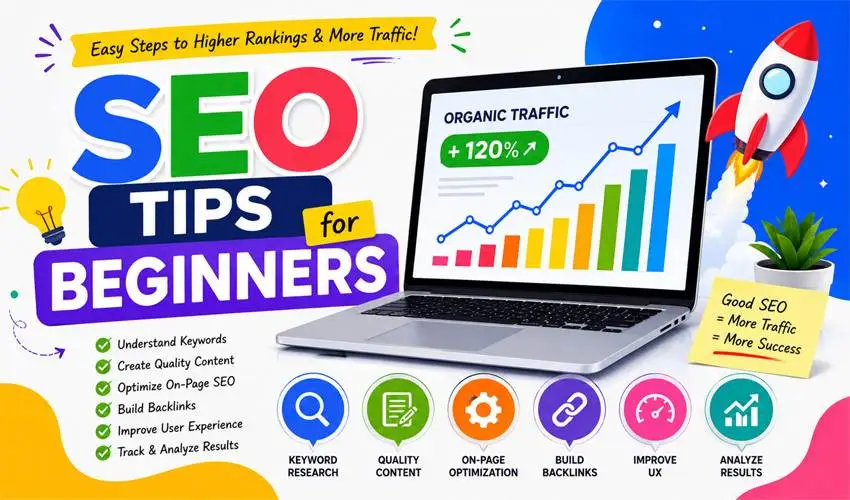
SEO Tips for Beginners: A Complete Guide to Getting Found Online
Every day, over 8.5 billion searches are performed on Google alone. Behind each one is a person looking for an answer, a product, a service, or a story. The question is: will they find your website — or your competitor’s?
Search Engine Optimization, or SEO, is the practice of making your website more visible in search engine results. It sounds technical, and at times it can be, but the foundational principles are surprisingly straightforward. Whether you’ve just launched your first blog, opened an online store, or built a business website, learning SEO early gives you a compounding advantage that pays off for years.
This guide walks you through the most impactful SEO tips for beginners — no jargon overload, no fluff, just actionable steps you can start applying today.
1. Understand How Search Engines Work
Before optimizing anything, you need to understand what you’re optimizing for. Search engines like Google use automated programs called “crawlers” or “spiders” to scan websites across the internet. They read your content, follow your links, and store information in a massive database called an index.
When someone types a query, the search engine pulls results from that index and ranks them based on hundreds of factors — relevance, authority, page speed, and user experience among them. Your job as a website owner is to make it as easy as possible for search engines to find, understand, and trust your content.
2. Do Keyword Research Before You Write Anything
Keywords are the bridge between what people search for and what your content offers. Keyword research is the process of finding those exact phrases so you can create content that matches real search intent.
Start with free tools like Google Keyword Planner, Ubersuggest, or Google Search Console. Type in a broad topic related to your niche and look for keywords that have decent search volume but aren’t dominated by massive authority websites.
As a beginner, focus on long-tail keywords — phrases of three or more words like “best running shoes for flat feet” rather than just “running shoes.” Long-tail keywords are less competitive and attract visitors who are closer to taking action.
Always consider search intent: is the person looking to learn something (informational), buy something (transactional), or find a specific website (navigational)? Match your content type to that intent, and you’ll rank much more effectively.
3. Optimize Your On-Page Elements
On-page SEO refers to everything you control directly on your webpage. Here are the key elements to get right:
Title Tag: This is the clickable headline shown in search results. Keep it under 60 characters, include your primary keyword near the beginning, and make it compelling enough to earn the click.
Meta Description: Though not a direct ranking factor, a well-written meta description increases click-through rates. Aim for 150–160 characters, summarize what the page offers, and include the keyword naturally.
Header Tags (H1, H2, H3): Use one H1 per page (usually the article title), and structure the rest of your content with H2s and H3s. This helps both readers and search engines understand your content hierarchy.
URL Structure: Keep URLs short, descriptive, and keyword-rich. A URL like /seo-tips-beginners is far better than /post?id=4829.
Image Alt Text: Search engines can’t see images — they read alt text. Describe your images accurately and include a keyword where it fits naturally.
4. Create High-Quality, Original Content
Content is still the backbone of SEO. Google’s algorithms are increasingly sophisticated at identifying genuinely helpful content versus keyword-stuffed filler.
Write content that thoroughly answers your reader’s question. A well-researched 1,200-word article that covers a topic comprehensively will almost always outperform a shallow 400-word post over the long run. Use subheadings to improve readability, include examples, and don’t be afraid to show genuine expertise.
Update your content regularly. A post about “best tools in 2023” that still ranks in 2026 will start losing ground unless you refresh it. Keeping content current signals to Google that your site is actively maintained.
5. Build a Strong Internal Linking Structure
Internal links are hyperlinks that point from one page on your website to another. They do two important things: they help search engines discover and index more of your content, and they distribute “link equity” — the ranking power — across your site.
Whenever you publish new content, link to it from relevant older posts. Conversely, link older high-performing pages to new ones you want to rank. Use descriptive anchor text (the clickable words) rather than generic phrases like “click here.”
A logical internal linking structure also improves user experience by guiding visitors to related content, reducing bounce rate, and increasing time on site — all of which send positive signals to search engines.
6. Focus on Technical SEO Basics
Technical SEO can sound intimidating, but as a beginner you only need to nail a few fundamentals:
Page Speed: Slow websites frustrate users and are penalized by Google. Use tools like Google PageSpeed Insights or GTmetrix to identify and fix speed issues. Compress images, enable browser caching, and consider a Content Delivery Network (CDN) if your audience is global.
Mobile-Friendliness: Over 60% of global web traffic comes from mobile devices. Google uses mobile-first indexing, meaning it primarily evaluates your mobile site. Use a responsive theme and test your site with Google’s Mobile-Friendly Test.
SSL Certificate (HTTPS): If your site still uses HTTP, it’s flagged as “Not Secure” in browsers and receives a slight ranking penalty. Most hosting providers offer free SSL certificates — there’s no excuse not to have one.
XML Sitemap: A sitemap is a file that lists all your important pages, helping search engines crawl your site more efficiently. Most SEO plugins like Yoast or Rank Math generate one automatically.
7. Earn Quality Backlinks
Backlinks — links from other websites pointing to yours — are one of the strongest ranking signals in SEO. Think of each backlink as a vote of confidence. The more credible sites that link to you, the more trustworthy your site appears to Google.
As a beginner, focus on earning links rather than buying or manipulating them. Strategies that work well include:
- Guest posting on relevant blogs in your niche
- Creating link-worthy assets like original research, infographics, or comprehensive guides
- Getting listed in industry directories or local business listings
- Reaching out to websites that have mentioned you without linking
Avoid low-quality link farms or paid link schemes. These can trigger Google penalties that are very difficult to recover from.
8. Set Up Google Search Console and Google Analytics
You can’t improve what you don’t measure. Google Search Console is a free tool that shows you which queries bring people to your site, which pages rank, and any technical errors Google encounters while crawling. It’s essential for every website owner.
Google Analytics (or its successor, GA4) shows you how visitors behave on your site — where they come from, which pages they visit, how long they stay, and where they leave. Together, these two tools give you the data you need to make smart SEO decisions.
Set them up immediately, even if you don’t know how to use every feature yet. You’ll want the historical data later.
9. Be Patient and Consistent
Perhaps the most important SEO tip for beginners is this: SEO is a long game. New websites typically take three to six months before seeing significant organic traffic, and competitive keywords can take a year or more to rank for. This is normal.
What separates successful SEO practitioners from those who give up is consistency. Publish content regularly, keep optimizing existing pages, build links steadily, and track your progress. Small, consistent efforts compound over time into significant results.
Conclusion
SEO doesn’t require a technical degree or a massive budget — it requires understanding your audience, creating genuinely useful content, and following a set of well-established best practices. The tips covered in this guide — from keyword research and on-page optimization to technical fundamentals and link building — are more than enough to get you started on the right foot.
Begin with one or two areas, master them, and then build from there. Every page you optimize, every quality article you publish, and every backlink you earn is an investment in long-term, sustainable traffic that no paid ad can match.
Start today. The best time to optimize your website was when you launched it. The second-best time is right now.