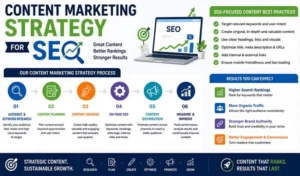
Creating high quality content for SEO is no longer just about stuffing keywords into a blog post and hoping for the best. Search engines have evolved dramatically, and today Google rewards content that genuinely helps users, demonstrates real expertise, and delivers a satisfying experience from the very first click.
Yet many website owners and marketers still struggle to bridge the gap between writing content and ranking for it. The truth is that both goals are achievable at the same time — when you approach content creation with a clear strategy, a deep understanding of your audience, and a commitment to quality over quantity.
This guide walks you through everything you need to know about creating SEO content that ranks, engages, and converts.
1. Start with Thorough Keyword Research
Every piece of high quality SEO content begins long before a single word is written. Keyword research is the foundation — it tells you what your audience is searching for, how competitive those topics are, and where genuine opportunities exist.
Start by identifying your primary keyword — the main topic you want to rank for. Then dig deeper into related terms, long-tail variations, and semantic keywords. Tools like Google Keyword Planner, Ahrefs, Semrush, and even Google’s own “People Also Ask” and autocomplete features can reveal what real users are typing into search engines.
Pay close attention to search intent. Is the person looking to learn something (informational), buy something (transactional), or find a specific website (navigational)? A piece of content optimized for the wrong intent will struggle to rank no matter how well it is written. If someone searches “best running shoes for flat feet,” they want a product comparison — not a lesson on foot anatomy.
Focus on choosing keywords that have a reasonable search volume with manageable competition, especially if your site is newer. Targeting ultra-competitive terms right away is rarely effective; instead, build authority gradually through a mix of niche and broader topics.
2. Understand Your Audience at a Deep Level
High quality content speaks directly to the reader. Before you write, build a clear picture of who you are writing for. What are their pain points? What questions do they have? What level of knowledge do they bring to the topic?
Go beyond basic demographics. Read comments on industry blogs, explore Reddit threads and Quora questions in your niche, and study the reviews of competing products or services. This kind of audience research surfaces the exact language, concerns, and frustrations your readers bring to the table — and that intelligence makes your content feel personal and authoritative rather than generic.
When your content resonates with readers, they stay longer on the page, engage more deeply, and are more likely to share it. All of these behaviors send strong positive signals to search engines.
3. Build a Strong, Logical Content Structure
Even brilliant ideas fail to connect if they are poorly organized. Search engines and readers both appreciate content that is easy to navigate and logically structured.
Use a clear hierarchy: one H1 heading for the main title, followed by H2 headings for major sections, and H3 subheadings where needed for subtopics. This structure makes your content scannable — a critical quality given that most users skim before they read.
Open with a compelling introduction that clearly states what the reader will gain. Then develop your main points in a logical order, each one building on the last. Close with a strong conclusion that summarizes key takeaways and, where appropriate, includes a call to action.
Aim for a natural flow between sections. Abrupt transitions or unclear connections between ideas make readers — and crawlers — work harder than they should. Short paragraphs, clear sentences, and occasional bullet points or numbered lists improve both readability and comprehension.
4. Write for E-E-A-T: Experience, Expertise, Authoritativeness, and Trustworthiness
Google’s quality guidelines place enormous emphasis on E-E-A-T — Experience, Expertise, Authoritativeness, and Trustworthiness. This framework is especially critical for content in categories that affect people’s health, finances, safety, or major life decisions.
To demonstrate experience, write from first-hand knowledge wherever possible. Share real examples, case studies, and personal insights that only someone who has actually dealt with the topic would know. Generic overviews that could have been written by anyone tend to perform poorly in competitive niches.
Expertise is shown through depth, accuracy, and precision. Cite credible sources, link to authoritative references, and avoid vague or unsubstantiated claims. If you are covering a technical subject, show that you understand the nuances — not just the surface-level facts.
Authoritativeness grows over time as other reputable sites link to your content and your brand becomes recognized within its niche. Trustworthiness is built through transparent authorship, clear contact information, honest writing, and consistently reliable information.
5. Optimize On-Page SEO Elements
Quality content without proper on-page optimization leaves performance on the table. Once you have written your article, make sure the technical signals are properly in place.
Include your primary keyword naturally in the title tag, the first paragraph, at least one subheading, and the meta description. Avoid keyword stuffing — modern search algorithms detect unnatural repetition and may penalize it. Instead, use related terms and synonyms throughout the piece to build topical relevance.
Write a compelling meta description of 150 to 160 characters that accurately summarizes the content and includes the main keyword. While the meta description is not a direct ranking factor, it significantly influences click-through rates — which do affect your performance in search results.
Optimize images with descriptive file names and alt text. Use short, descriptive URLs that include your target keyword rather than strings of numbers or random characters. Internally link to other relevant pages on your site to help search engines understand your content hierarchy and keep users engaged.
6. Prioritize Depth and Originality Over Length
There is a persistent myth in SEO that longer content always ranks better. In reality, content should be exactly as long as it needs to be to fully address the topic — no more, no less. Padding content with unnecessary repetition or tangential information actually harms user experience and signals low quality.
What matters more than raw word count is genuine depth. Cover your topic comprehensively. Answer the obvious questions and anticipate the follow-up ones. Provide context that helps the reader understand not just the “what” but the “why” and “how.”
Originality is equally important. Rehashing what dozens of other websites have already said adds nothing to the web. Bring something new to every piece — a unique perspective, fresh data, an underexplored angle, or simply clearer and more useful explanations than what currently exists.
7. Keep Content Fresh and Updated
Search engines favor content that remains accurate and current over time. A well-performing article left untouched for years will eventually slip in rankings as newer, fresher content appears.
Build a habit of revisiting your top-performing pages regularly. Update statistics, replace outdated examples, add new sections to reflect industry changes, and refresh internal links as you publish new content. In many cases, updating an existing article is more effective than creating a new one on the same topic.
Adding a “last updated” date — and genuinely updating the content, not just the date — also builds reader trust. It signals that a real person is maintaining the information.
8. Make Readability and User Experience Non-Negotiable
Even the most well-researched content will underperform if it is hard to read. Poor readability leads to high bounce rates and short time-on-page metrics, both of which can negatively impact rankings.
Aim for a reading level appropriate to your audience. Use active voice, short sentences, and plain language wherever possible. Break up walls of text with subheadings, white space, and visual elements like images, infographics, or embedded videos.
Page speed, mobile responsiveness, and accessibility also fall under the umbrella of user experience. A slow-loading page or one that displays poorly on a smartphone will push users away regardless of how good the content is.
Conclusion
Creating high quality content for SEO is both a science and a craft. It requires understanding search algorithms and human behavior in equal measure. When you combine rigorous keyword research with genuine expertise, thoughtful structure, on-page optimization, and a relentless focus on the reader’s experience, the result is content that earns rankings — and keeps them.
The most successful SEO content is not written for Google. It is written for real people, optimized for discovery, and built to last. Start with that mindset, and the rankings will follow.